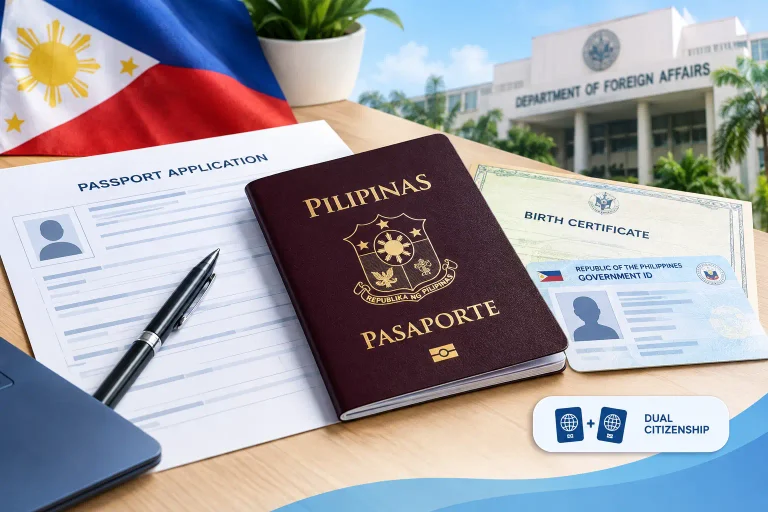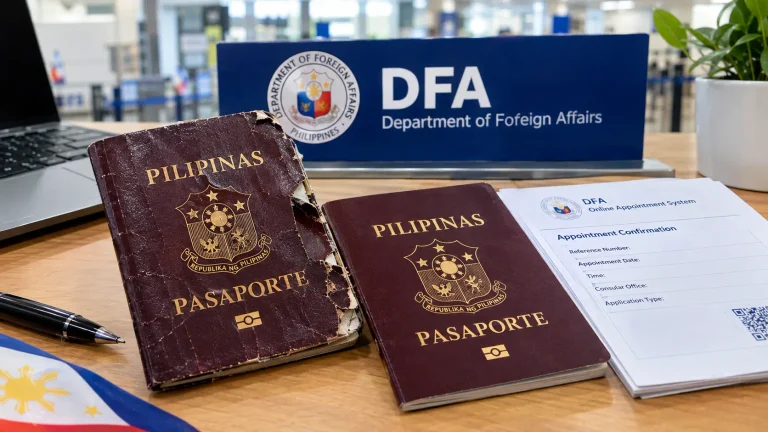
Philippine Passport Requirements Checklist for All Applicants & Valid IDs
Standing in line at the DFA only to be told you are missing one document is one of the most frustrating ways to lose an entire day. Passport requirements in the Philippines change depending on whether you are a first-time applicant, renewing an old passport, replacing a lost one, or applying on behalf of a child, and mixing up these lists is the most common reason applications get sent back.
This guide breaks down what you generally need for each applicant type, which valid IDs the DFA commonly accepts, and the small mistakes that cause the most rejections. Requirements can vary slightly by branch or individual case, so always confirm the current list on the official DFA appointment system before your visit.
Philippine Passport Requirements
Every passport application in the Philippines runs through the Department of Foreign Affairs, and the paperwork you prepare depends heavily on your specific situation. A single mother applying for her child needs a different folder of documents than a senior citizen renewing an expired passport, even though both are technically going through the same government office. Reading through the correct category before you book your appointment saves you from showing up with the wrong set of papers.
Who Needs These Requirements?
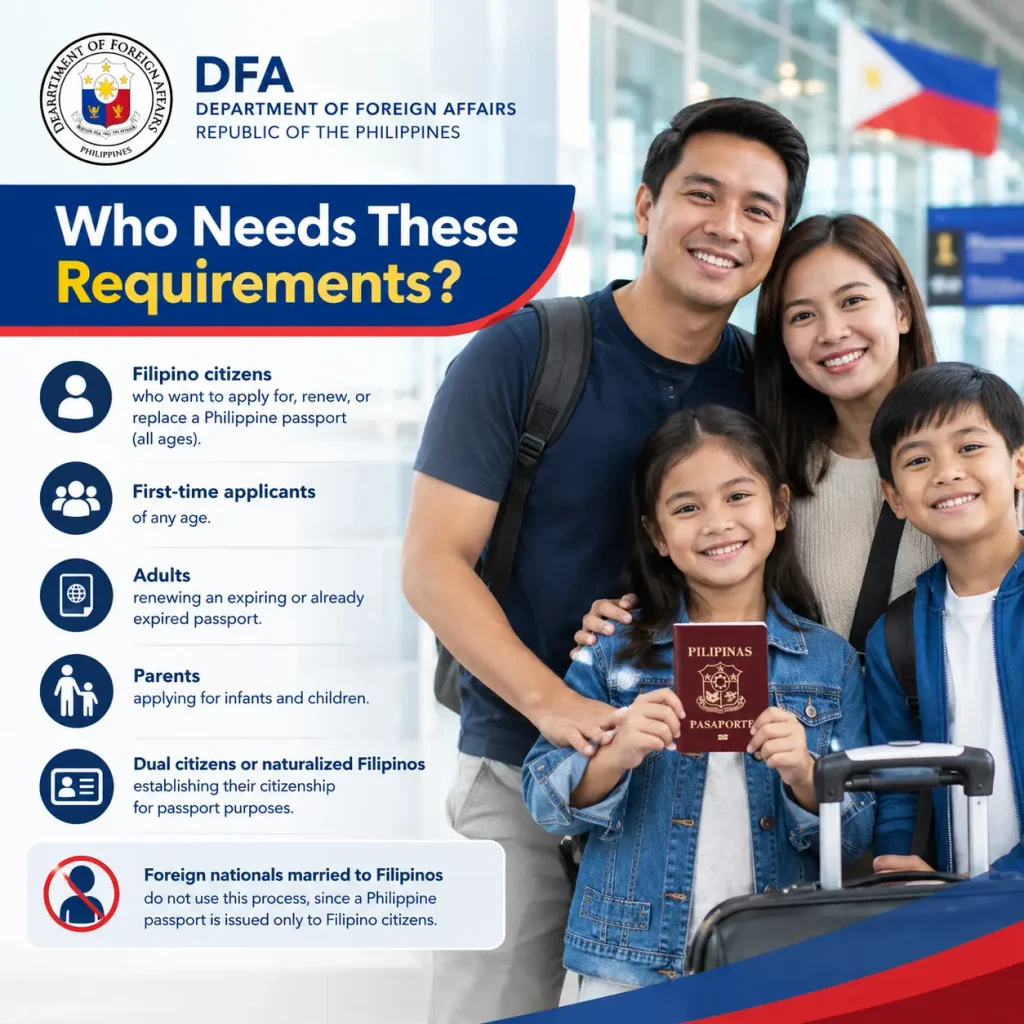
Anyone who is a Filipino citizen and wants to apply for, renew, or replace a Philippine passport needs to meet these requirements, regardless of age. This includes first-time applicants of any age, adults renewing an expiring or already expired passport, parents applying for infants and children, and dual citizens or naturalized Filipinos establishing their citizenship for passport purposes. Foreign nationals married to Filipinos do not use this process, since a Philippine passport is issued only to Filipino citizens.
Basic Eligibility
To qualify for a Philippine passport, you must be a Filipino citizen by birth, naturalization, or reacquisition under the Citizenship Retention and Reacquisition Act. You also need to book a confirmed DFA appointment online, since walk-in applications are generally not accepted outside select Courtesy Lane categories. Walk-in or Courtesy Lane availability depends on the applicant category and current DFA rules, so check the official passport appointment system before visiting if you believe you qualify. Personal appearance is required for every applicant, including infants, since biometric data must be captured directly at the DFA office. Once you have gathered the required documents, follow this guide to understand the Philippine passport application process and prepare for your next steps.
Documents Required for a Philippine Passport
The core paperwork for a Philippine passport centers around proving your identity, your citizenship, and, where relevant, your civil status. Getting these documents ready before booking your appointment is the single biggest step toward a smooth application.
PSA Civil Registry Documents
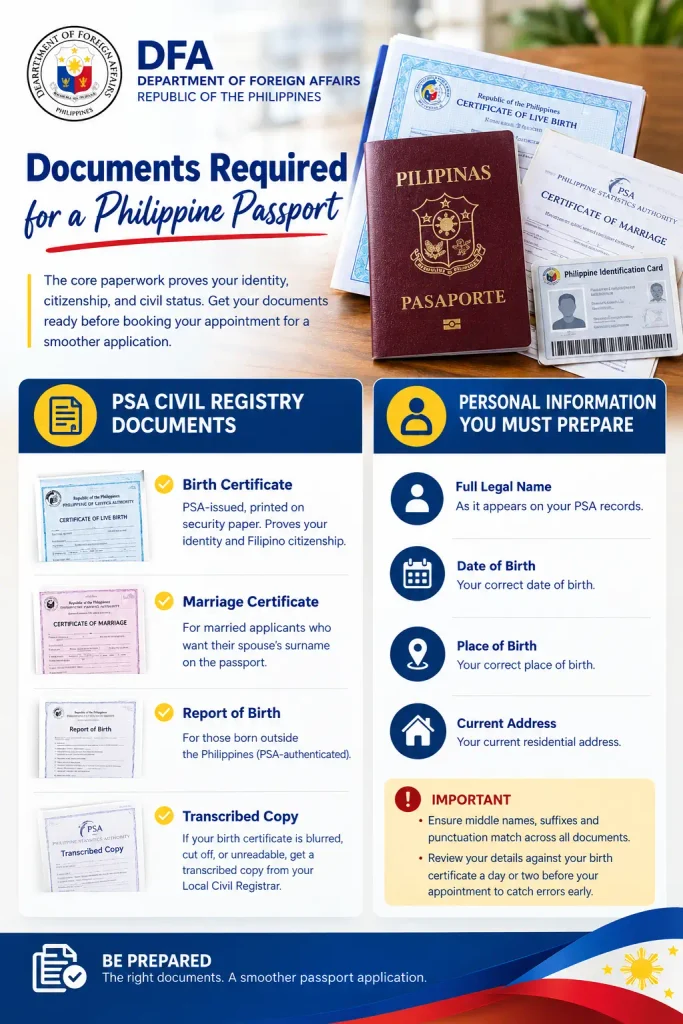
A PSA-issued birth certificate printed on security paper is the foundation of many first-time and special-case passport applications, since it proves both your identity and your Filipino citizenship. Renewal applicants typically rely on their existing passport instead, so a birth certificate is not always required at that stage. If your birth certificate entries are blurred, cut off, or otherwise unreadable, you will need a transcribed copy from your Local Civil Registrar instead. Applicants born outside the Philippines need a Report of Birth authenticated by the PSA rather than a standard birth certificate. Married applicants who want their spouse’s surname reflected on the passport also need an original PSA-authenticated marriage certificate.
Personal Information You Must Prepare
Beyond physical documents, you need to know your complete legal name exactly as it appears on your PSA records, your correct date and place of birth, and your current address. Middle names, suffixes, and even punctuation should match across every document you bring, since small inconsistencies are one of the most common reasons applications get delayed. Reviewing this information against your birth certificate a day or two before your appointment catches most errors before they become a problem at the counter.
Accepted Valid IDs for Passport Application
The DFA generally asks for one original valid government-issued ID along with a clear photocopy, though bringing a second ID is a smart backup in case your primary choice is questioned.
Primary Government-Issued IDs
The following IDs are commonly accepted as primary identification for a passport application.
| Accepted Primary ID | Notes |
| PhilSys National ID (physical PhilID, ePhilID, or Digital PhilID) | Officially mandated under the Philippine Identification System Act |
| Driver’s License | Issued by the LTO; must be current and unexpired |
| UMID Card | Unified Multi-Purpose ID (SSS/GSIS) |
| SSS ID / GSIS ID | For members of either system |
| PRC ID | For licensed professionals |
| COMELEC Voter’s ID or Voter’s Certification | Issued by COMELEC |
| Senior Citizen ID | For qualified senior applicants |
| OWWA ID | For registered overseas Filipino workers |
| Seafarer’s documents (Seaman’s Book / SIRB) | For seafarers |
| Postal ID | Accepted depending on issuance date and format |
This list reflects commonly cited primary IDs, but the DFA periodically updates which IDs it accepts. Confirm the current accepted-ID list on the official DFA or passport appointment website before your appointment, since requirements can vary slightly by branch.
Other Accepted Supporting IDs
If you do not have a primary ID, it is best to check directly with your chosen DFA branch or the official appointment system about which supporting documents, if any, they will accept for your specific case. Requirements here can vary by branch and by applicant category, so confirming in advance avoids being turned away on appointment day.
Passport Requirements by Applicant Type
Requirements shift noticeably depending on whether this is your first passport, a renewal, or an application for a child.
First-Time Applicants
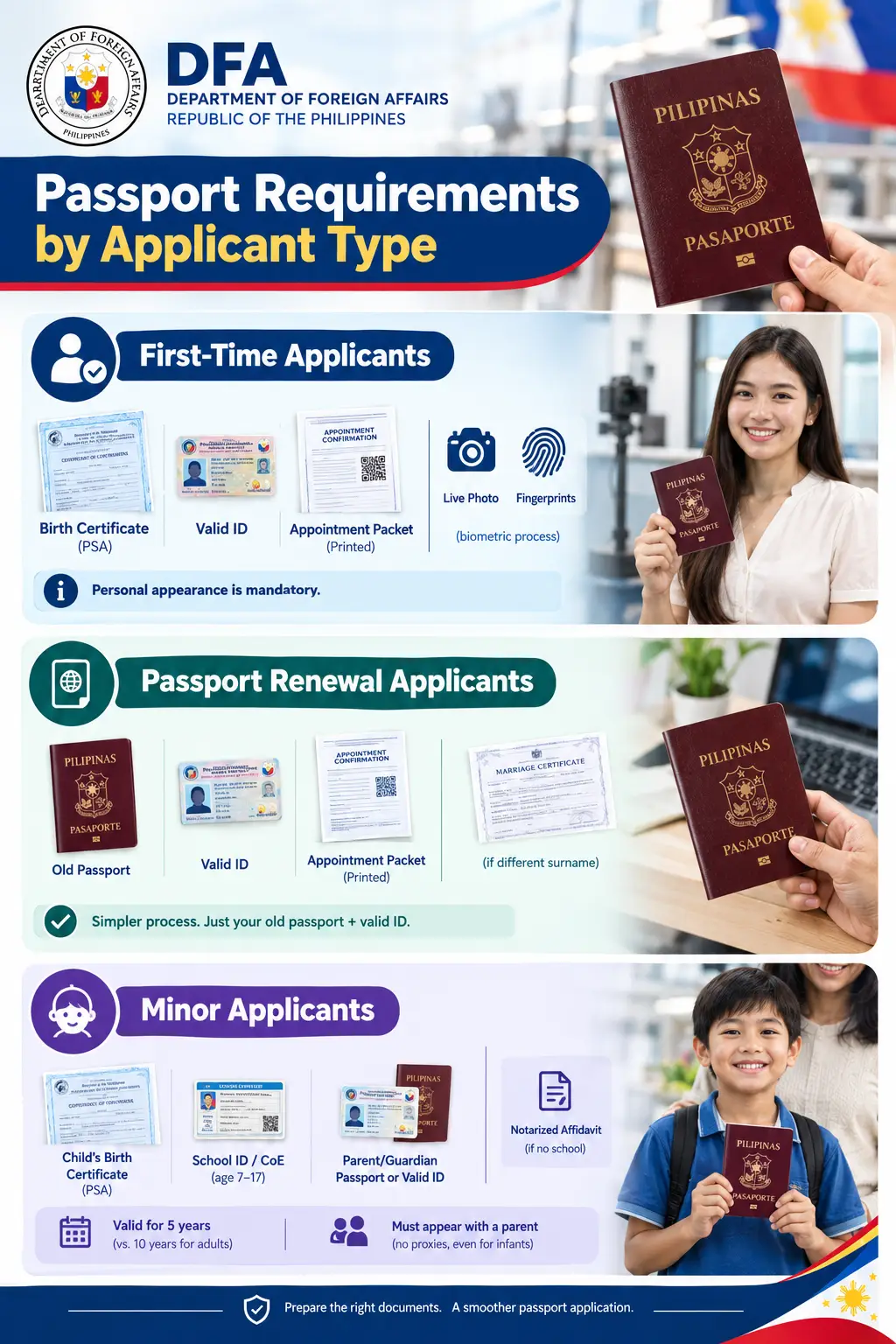
First-time applicants need a PSA-issued birth certificate, one valid government-issued ID, and a printed confirmed appointment packet. Your visit includes a live photo and fingerprint capture as part of the standard biometric process. Under the Philippine Passport Act, personal appearance is mandatory specifically so the DFA can confirm identity and citizenship at this stage.
Passport Renewal Applicants
Renewal is generally a simpler category on paper, since you mainly need your old passport and one valid ID, along with your confirmed appointment packet. If your old passport was issued under a different surname due to marriage, bring your PSA marriage certificate as well to reflect the correct name.
Minor Applicants
Minors need their own confirmed appointment and must personally appear alongside a parent or legal guardian, since proxies are not accepted even for infants. Core documents include the child’s PSA birth certificate, a school ID or Certificate of Enrollment with photo for children aged seven to seventeen, and the passport or valid ID of the accompanying parent or guardian. If the child has never attended school, a notarized affidavit explaining this replaces the school ID requirement. Passports for minors are valid for five years rather than the ten-year validity given to adults, since facial features change quickly during childhood.
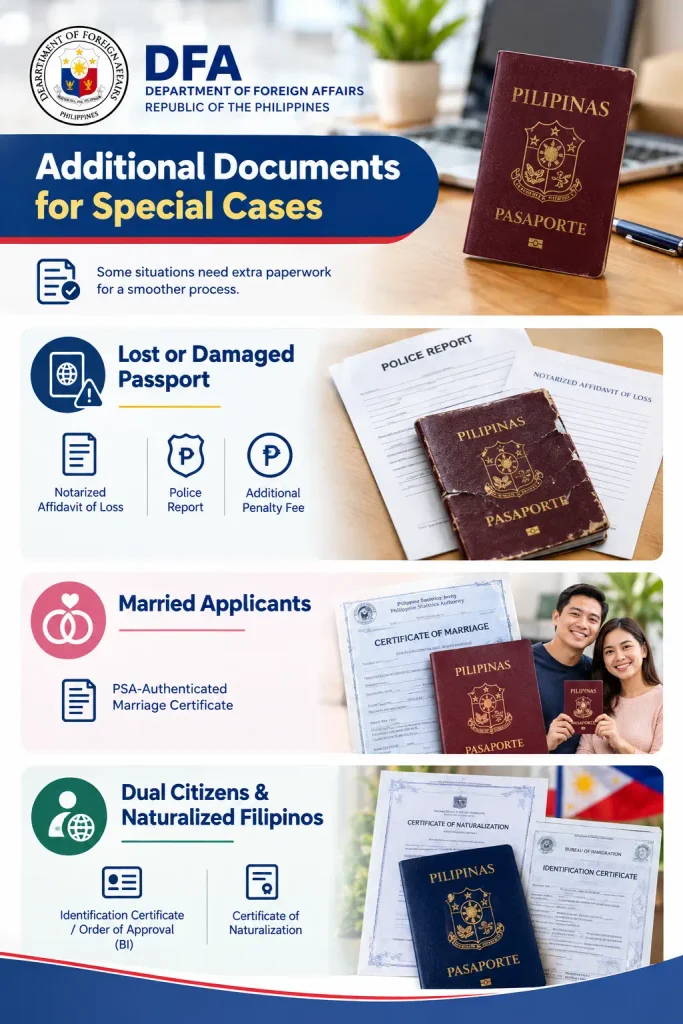
Additional Documents for Special Cases
Some situations call for extra paperwork on top of the standard requirements, and skipping these documents is one of the fastest ways to get turned away.
Lost or Damaged Passport
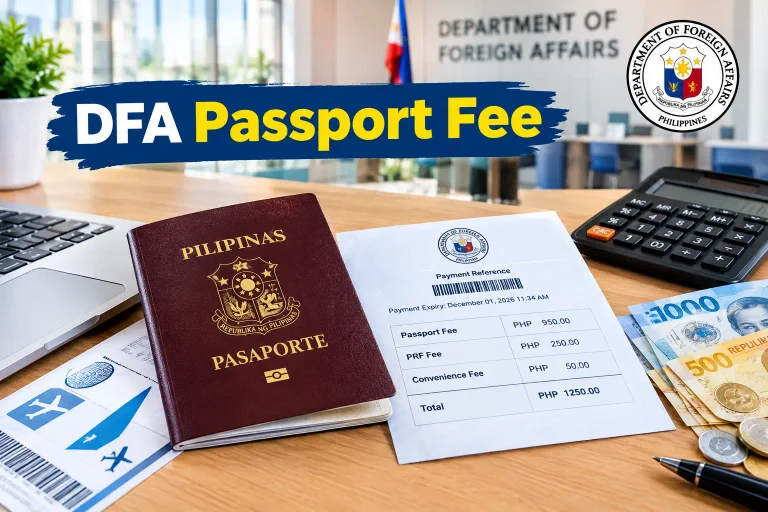
A lost passport is treated as a security concern rather than a routine renewal, which means you need a notarized affidavit of loss and a police report describing the circumstances, in addition to the standard documents for your applicant type. Expect an additional penalty fee on top of your regular or expedited processing fee, and your application may be subject to a clearing period, since the DFA verifies that the lost passport was not used fraudulently before issuing a replacement. A damaged or mutilated passport follows a similar path, where you bring the damaged document itself along with a written explanation of what happened. In addition to preparing your documents, review the current DFA passport fees to understand the expected application costs.
Married Applicants
Applicants who want their spouse’s surname on their passport need to present an original PSA-authenticated marriage certificate. If you are changing your civil status from single to married on an existing passport, this same marriage certificate supports that update, along with your current passport and a valid ID. Women who prefer to keep their maiden name are not required to submit a marriage certificate for this purpose, since using a maiden name remains a valid option under Philippine law.
Dual Citizens and Naturalized Filipinos
Dual citizens who reacquired Filipino citizenship need to present their Identification Certificate or Order of Approval from the Bureau of Immigration, along with the standard PSA documents. Naturalized Filipinos typically need their Certificate of Naturalization or similar proof of citizenship in addition to a valid ID.
Common Document Mistakes to Avoid
A surprising number of appointment-day problems come down to small, avoidable errors rather than missing an entire document.
Name or Birth Date Mismatch
When your ID spells your name slightly differently than your birth certificate, or your ID shows a different birth date, a discrepancy like this may require additional verification or supporting documents. Reviewing every document side by side before your appointment, checking spelling, middle & names etc.
Expired or Unacceptable IDs
An expired driver’s license or an ID that is not on the DFA’s current accepted list will not be honored at the counter, even if it was valid a year ago. Checking your ID’s expiration date and confirming it appears on the official accepted list before you book your appointment avoids an unnecessary rejection.
Missing Original Documents
Photocopies alone are not accepted for your primary documents, since DFA staff need to verify authenticity against the original. Forgetting your original PSA birth certificate or original valid ID at home, even if you remembered the photocopy, means you will likely need to reschedule your entire appointment.
Tips Before Visiting the DFA
Organize both originals and photocopies of every required document into one folder so you are not searching through your bag at the counter. Confirm your requirements against your specific applicant type, since bringing a renewal document set to a first-time application, or the reverse, wastes your slot. Arrive fifteen to twenty minutes early and bring your printed appointment confirmation, and check your chosen branch’s current dress code and other on-site guidelines beforehand since these can vary.
Frequently Asked Questions
Final Thoughts
Passport requirements in the Philippines are not complicated once you know exactly which category applies to your situation, whether that is a first-time application, a renewal, a lost passport replacement, or a minor’s passport. The documents themselves rarely change dramatically from year to year, but small details like ID expiration dates, name spelling, and which supporting papers apply to your case are where most delays happen. Preparing your folder carefully before booking your DFA appointment is the difference between an easy visit and a wasted trip.